


Featured image for "How to Write a Condolence Message: The 2026 Ultimate Guide"

A Personal Note from आदित्य
"Hello! I've spent time compiling this comprehensive 25 min read guide on Guides to help you navigate this emotional journey. My goal is to make finding the right words seamless and comforting for you."
"Grief is not a problem to be solved; it is a presence to be carried." When someone we care about experiences the earth-shattering loss of a loved one, the world around them stops. In those silent, dark days of early mourning, finding the right words to express our shared sorrow is a daunting task. We worry about saying the wrong thing, sounding cliché, or invading their privacy. This guide is built to help you navigate this delicate space. Whether you need a short condolence message to send over WhatsApp, a formal card message for a colleague, or templates on how to reply when receiving condolences yourself, you will find human-centered, respectful wording for every situation below.
📑 What is Covered in This Ultimate Guide?
- ➔ 1. What is a Condolence Message?
- ➔ 2. The Psychology of Empathy & Grief Support
- ➔ 3. A Step-by-Step Writing Framework
- ➔ 4. Short and Simple Condolence Messages
- ➔ 5. Messages Categorized by Relationship
- ➔ 6. Religious & Cultural Sympathy Wording
- ➔ 7. Etiquette: How and When to Send
- ➔ 8. How to Reply/Respond to Condolences
- ➔ 9. Ready-to-use Response Templates
- ➔ 10. Frequently Asked Questions (FAQ)
1. What is a Condolence Message?
A condolence message (or sympathy message) is a formal or informal expression of sorrow, support, and empathy sent to someone who is grieving the death of a family member, partner, or close friend. Derived from the Latin word condolere, which literally means "to suffer together," a condolence note acts as a tangible reminder to the bereaved that they are not alone in their isolation.
Unlike casual greetings, a condolence note requires a tone of solemnity, respect, and emotional sensitivity. Its primary goal is not to fix the grief—because grief is not a broken object that can be repaired with sentences—but to acknowledge the reality of the loss and to offer a steady hand in the darkness.
It is important to distinguish condolence messages from related terms:
- Sympathy Card: The physical greeting card containing printed words of comfort, inside which you write your personal condolence message.
- RIP Message (Rest in Peace): A short, often traditional declaration (or acronym) focused on the peace of the departed soul, commonly used in digital spaces.
- Shradhanjali / Shok Sandesh (श्रद्धांजलि / शोक संदेश): The traditional Indian (Hindi) terms for condolence messages, mourning announcements, and prayer meeting invitations.
- Eulogy: A speech delivered at a funeral service that details the achievements and life story of the deceased.
2. The Psychology of Empathy & Grief Support
Grief is a complex, chaotic, and non-linear emotional state. When a person is grieving, their cognitive processing is often overwhelmed by shock, exhaustion, and sadness. Therefore, when writing a condolence note, understanding the psychological landscape of the recipient is crucial. Empathy must guide your pen.
🚫 What to Avoid Saying (Well-Intentioned but Hurtful Phrasing)
Often, in our desperation to ease someone's pain, we fall back on platitudes that inadvertently invalidate their grief. Here are a few common phrases to steer clear of:
- ❌ "I know exactly how you feel." (Every loss is deeply unique. Even if you have lost a parent, you do not know exactly how this specific person feels.)
- ❌ "They are in a better place." (While meant as a spiritual comfort, to a grieving person, the 'best' place for their loved one is alive with them.)
- ❌ "Everything happens for a reason." (This can sound dismissive or cruel, implying that the death was a necessary part of some plan.)
- ❌ "Call me if you need anything." (This places the cognitive burden of reaching out on the grieving person. Instead, offer specific help.)
To write an authentic sympathy message, shift your focus from *solving* the sadness to *witnessing* it. Good sympathy notes are simple, honest, and supportive. They do not minimize the loss or try to put a positive spin on a tragedy. They stand in solidarity with the person's pain.
3. A Step-by-Step Writing Framework
If you are struggling to write, breaking down the message into a structural anatomy can make the task much easier. A traditional, highly respectful condolence message follows a 5-step framework:
The Salutation
Start with a warm, respectful greeting. Use "Dear [Name]" for friends and family, or "Respected [Name]" or "Dear Mr./Ms. [LastName]" for professional relationships.
Acknowledge the Loss
State your shock or sorrow directly. Mention the deceased by name if possible (e.g., "I was deeply saddened to hear about the passing of your mother, Clara").
Share a Memory or Praise Their Character
Recall a specific moment or mention an admirable quality (e.g., "She had a way of making everyone in the room feel welcomed and loved. Her laughter was contagious"). This brings immense comfort.
Offer Support or a Prayer
Reassure them of your presence. Provide specific assistance (e.g., "I will drop off some dinner for your family on Thursday," or "Please know that we are keeping you in our thoughts and prayers").
A Dignified Sign-off
Close with an empathetic phrase instead of standard business sign-offs. Use: "With deepest sympathy," "Wishing you peace," "In loving memory," or "My heart goes out to you."
4. Heartfelt & Short Condolence Messages
Sometimes, a simple and direct message is the most appropriate, especially if you are sending a text message or a WhatsApp note. A short condolence message conveys your sympathy immediately without overwhelming the grieving family. Here are several short, modern templates you can easily copy and send:
"My heart goes out to you and your family during this incredibly difficult time. Wishing you strength and comfort."
"Please accept my deepest condolences. Your family is in my thoughts and prayers as you navigate this profound loss."
"I am so deeply sorry for your loss. May the beautiful memories of your loved one bring you peace in the days ahead."
"Words cannot express the sorrow I feel for your loss. Wishing you comfort, healing, and peace."
"शोक संतप्त परिवार के प्रति हमारी गहरी संवेदनाएं। ईश्वर दिवंगत आत्मा को शांति और आपको इस कठिन समय में संबल प्रदान करें।"
"दिवंगत आत्मा को भावपूर्ण श्रद्धांजलि। दुख की इस घड़ी में हमारी प्रार्थनाएं आपके और आपके परिवार के साथ हैं। ॐ शांति।"
5. Condolence Messages by Relationship
Your connection to the deceased or to the grieving individual will dictate the level of personal detail and the overall tone of your message. Here is a curated selection of condolence messages on death tailored for specific relationships:
👩👧 Wording for the Loss of a Mother
A mother’s love is irreplaceable. The loss of a mother leaves a unique void in one's life. When expressing condolences, focus on her warmth, gentle spirit, and the eternal legacy of her love.
"Your mother was a truly beautiful soul. Her kindness, warmth, and grace touched everyone who met her. I am so incredibly sorry for your loss."
"A mother’s love is a guiding light that never truly fades. May you feel her gentle presence all around you in the quiet moments."
"पूज्य माताजी के निधन का समाचार सुनकर अत्यंत दुख हुआ। वे ममता और वात्सल्य की प्रतिमूर्ति थीं। भगवान उनकी पुण्य आत्मा को मोक्ष प्रदान करें।"
👨👦 Wording for the Loss of a Father
Fathers represent strength, support, and wisdom. When conveying condolences for a father's passing, it is respectful to reference his mentorship, principles, and the legacy he leaves behind in his children.
"Your father was a man of honor, strength, and immense integrity. I feel privileged to have known him. Please accept my deepest sympathies."
"Although your father is no longer with us physically, his guidance and values will live on through you forever. Thinking of you during this time."
"आपके पिताजी के स्वर्गवास की सूचना पाकर गहरा धक्का लगा। वे एक सहृदय और मार्गदर्शक पुरुष थे। इस कठिन परिस्थिति में मेरी गहरी संवेदनाएं आपके साथ हैं।"
❤️ Wording for the Loss of a Spouse or Partner
Losing a life partner is a deeply disruptive and painful experience. Wording here must be incredibly gentle and acknowledge the unique bond and companionship that was shared.
"The connection you and [Name] shared was truly inspiring. I cannot begin to imagine the depth of your grief. I am here for you, always."
"Words are inadequate to express the sorrow I feel for the loss of your partner. May love, friendship, and quiet moments bring you peace."
👫 Wording for the Loss of a Close Friend
Friends are the family we choose for ourselves. Losing a friend is losing a part of our history and shared memories. Focus on the joy, laughter, and unbreakable memories they created.
"I am devastated to hear about the passing of [Name]. They brought so much joy, laughter, and light into our lives. I will miss them dearly."
"A true friend is never forgotten. The beautiful memories we shared with [Name] will remain alive in our hearts forever."
💼 Wording for a Colleague or Co-worker
In a workplace context, condolence messages should strike a balance between professional dignity and genuine human compassion. Acknowledge their teamwork, positive work attitude, and presence in the office.
"Please accept our deepest condolences for your loss. [Name] was a highly valued colleague and a true pleasure to work with. They will be sorely missed by the entire team."
"On behalf of the entire company, we send our heartfelt sympathy to you and your family. We are wishing you strength during this time of mourning."
🐾 Wording for the Loss of a Pet (Dog/Cat)
For many, pets are full-fledged members of the family. The grief of losing a dog or cat is deeply real. Validate this loss by recognizing the loyal friendship and love they brought.
"Pets leave paw prints on our hearts forever. [PetName] was such a loyal, joyful companion, and I know how much you loved them. Thinking of you."
"I am so sorry to hear about the passing of [PetName]. They had a beautiful life full of love, walks, and endless treats. May those sweet memories comfort you."
6. Religious & Cultural Sympathy Wording
In multi-cultural societies, tailoring your condolence message to the recipient's spiritual beliefs or cultural traditions can offer deep comfort. However, if you are unsure of their beliefs, it is always safest to stick to secular wording.
✝️ Christian Wording & Bible Verses
Christian condolences focus on God's love, the promise of eternal life, resurrection, and peaceful rest in heaven. You can write:
"May God's love wrap around you and give you comfort. Our prayers are with you as you mourn. 'Blessed are those who mourn, for they shall be comforted.' — Matthew 5:4"
"Praying that the Lord holds you close in His embrace and gives you peace. May your loved one rest in the eternal light of Christ."
🕉️ Hindu Sympathy Wording (Shradhanjali)
Hindu condolences center on the immortality of the soul (Atman) and its journey to merge with the Supreme Divine (Paramatman). Popular phrases include 'Om Shanti' (ॐ शांति) and prayers for 'Moksha' (salvation).
"ॐ शांति। ईश्वर दिवंगत आत्मा को अपने श्रीचरणों में स्थान दें और शोकाकुल परिवार को इस भारी आघात को सहने की शक्ति प्रदान करें।"
"दिवंगत पुण्य आत्मा को हमारी भावभीनी श्रद्धांजलि। भगवान कृष्ण उनके मार्ग को आलोकित करें और आत्मा को वैकुंठ धाम में परम शांति दें।"
🌙 Islamic Sympathy Wording
Islamic condolences emphasize submission to Allah's decree and trust in His mercy. The classic Arabic phrase 'Inna lillahi wa inna ilayhi raji'un' (إِنَّا لِلَّٰهِ وَإِنَّا إِلَيْهِ رَاجِعُونَ) translates to "Indeed, to Allah we belong, and indeed to Him we will return."
"Inna lillahi wa inna ilayhi raji'un. May Allah (SWT) grant [Name] the highest place in Jannat-ul-Firdaus and grant sabr (patience) to the family during this trial."
"Please accept our heartiest condolences. May Allah forgive all their shortcomings, reward their good deeds, and bring comfort to the hearts of their loved ones."
7. Etiquette: How and When to Send
The medium you choose to deliver your condolences and the timing of your delivery are just as important as the words themselves. Let’s look at the modern etiquette of conveying sympathy:
⚡ The Rule of Promptness: Try to send your initial condolence message within 24 to 48 hours of hearing about the death. However, remember that "late condolences are better than no condolences." If you hear about the passing weeks or months later, still reach out with a gentle acknowledgment of the delay.
📱 Is it OK to send condolences via WhatsApp / Text?
Yes. In today’s interconnected digital age, sending a WhatsApp message is widely accepted and often preferred in the immediate aftermath of a loss. Why? Because a text message allows the grieving person to read your support without the pressure of having to speak on a phone call or face someone in person while in emotional shock.
However, follow these digital texting rules:
- ✔️ Keep it short and supportive.
- ✔️ Explicitly state that there is no need for them to respond (e.g., "Please do not worry about replying to this. Focus on yourself").
- ❌ Avoid using casual emojis like thumbs-up or crying faces. Stick to respectful symbols like 🕯️ (candle), 🕊️ (dove), or 🙏 (folded hands) if necessary, but text is safer.
- ❌ Avoid asking probing questions about the cause of death.
8. How to Reply/Respond to Condolences
When you are the one who has suffered the loss, receiving an outpouring of sympathy messages is comforting but can also feel overwhelming. Grieving families often struggle with the social expectation of responding to dozens or hundreds of messages.
Here are key guidelines on **how to reply condolence message** when you are ready:
⏱️ Timing Expectations & Social Boundaries
- ⌛ You do not need to reply immediately. People understand that you are in a state of mourning. Take days, weeks, or even months.
- ⌛ A simple "Thank you" is always sufficient. You do not need to write long paragraphs or explain the situation.
- ⌛ You can delegate the responses. A close relative, sibling, or partner can reply on your behalf or post a collective thank-you message on social media.
- ⌛ Use templates. To avoid spending valuable emotional energy writing individual responses, use simple, readymade templates to copy and paste.
9. Ready-to-use Response Templates
When responding to condolences, copying and adjusting a pre-written template is a highly effective way to handle communication without draining your emotional energy. Here are response templates categorized by platform:
"Thank you so much for your kind words and condolences. Knowing that you are thinking of us brings comfort to our family during this difficult time."
"शोक के इस कठिन समय में आपकी संवेदनाओं और सांत्वनापूर्ण शब्दों के लिए बहुत-बहुत धन्यवाद। आपकी प्रार्थनाएं हमारे लिए संबल हैं।"
"Our family would like to express our heartfelt gratitude to everyone who reached out with messages of support, phone calls, and flowers after the passing of our beloved [Name]. Your kindness and shared memories have helped us bear this immense loss."
"Thank you all for the kind condolences, support, and flowers. I deeply appreciate the team's understanding and coverage while I was away. I am grateful to work with such a compassionate group of people."
10. Frequently Asked Questions (FAQ)
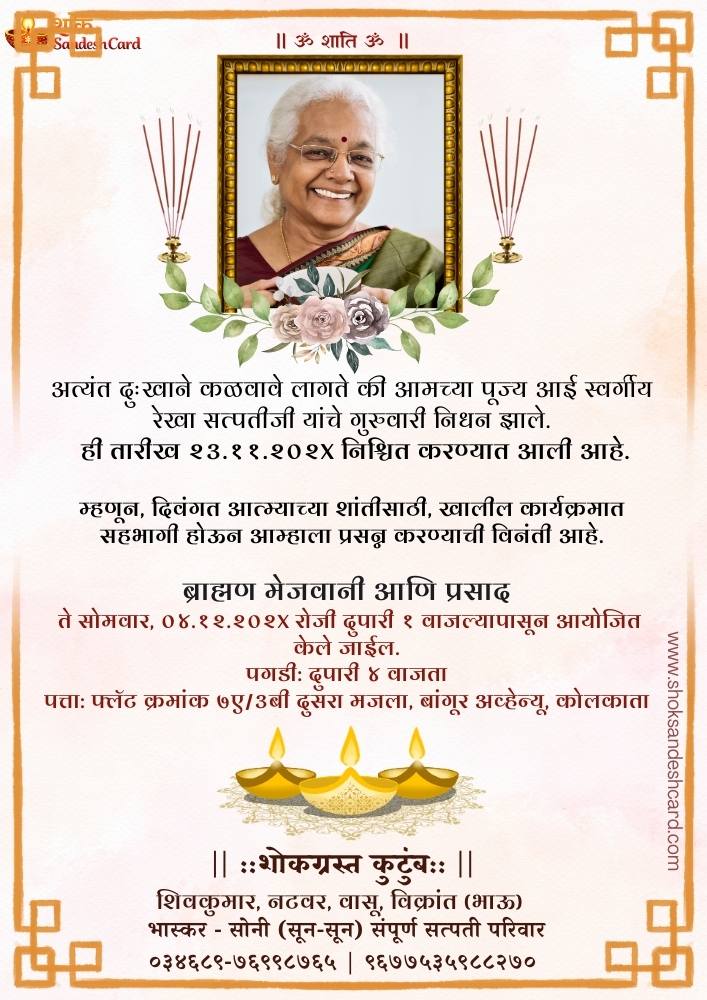
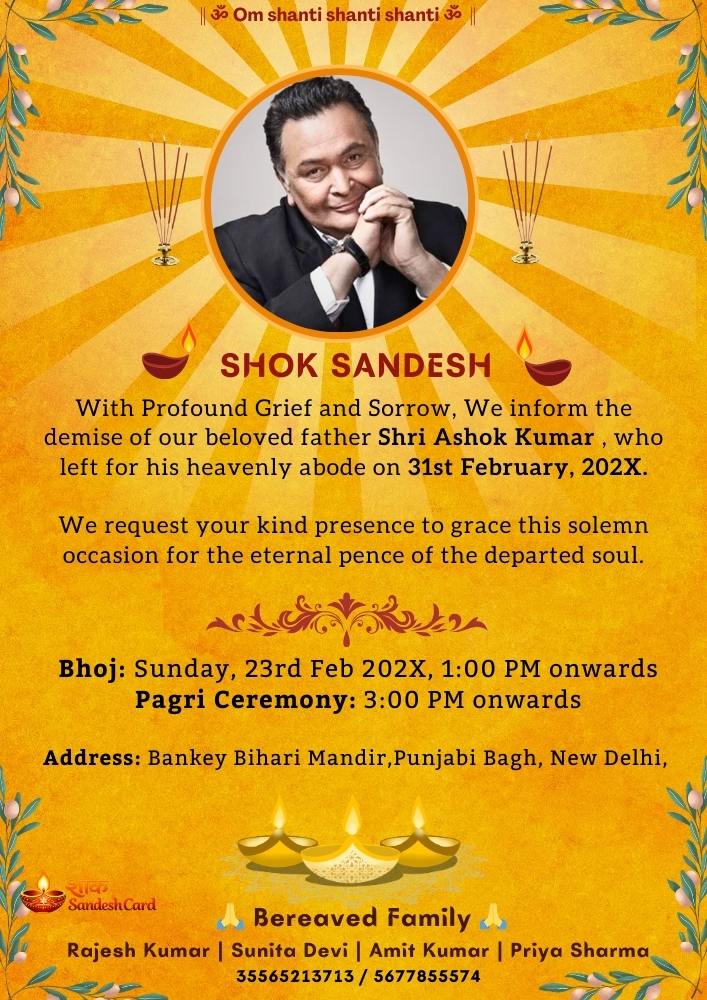
🕯️ Design a Dignified Shradhanjali or Shok Sandesh Card Online
Notify your family members and relatives with respect. Create a custom condolence invitation card in under 3 minutes using our specialized editor. Download high-resolution print PDF and WhatsApp images instantly.
हमारे सभी Card Templates देखें — सब Free
Photo, नाम और message के साथ customize करें — PDF + WhatsApp ready। Hindi, Marathi, Telugu, Tamil, English सब languages में।
🙏 Shradhanjali Card – श्रद्धांजलि कार्ड
Photo के साथ beautiful shradhanjali card — 14 designs
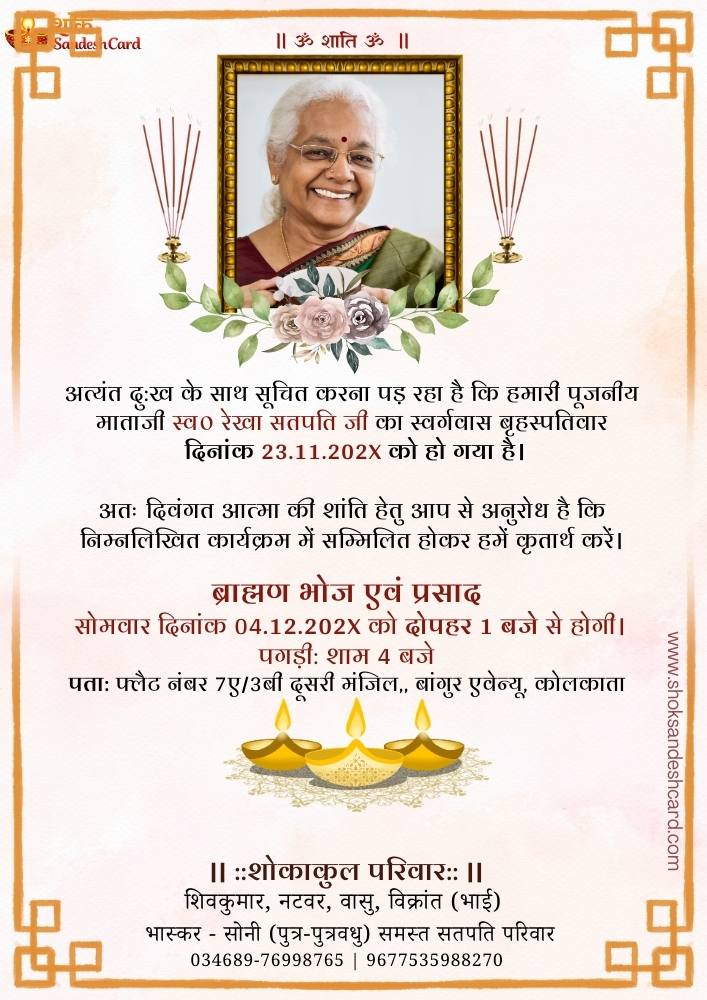





🇮🇳 Hindi Shok Sandesh Card – हिंदी शोक संदेश कार्ड
Hindi निधन सूचना / शोक संदेश कार्ड — 14 designs


🕉️ Tervi Invitation Card – तेरवीं निमंत्रण कार्ड
13वीं / तेरवीं रस्म के invitation card — 13 designs


🇮🇳 Marathi Shok Sandesh Card – मराठी निधन पत्रिका
मराठी शोक संदेश / निधन पत्रिका — 5 designs
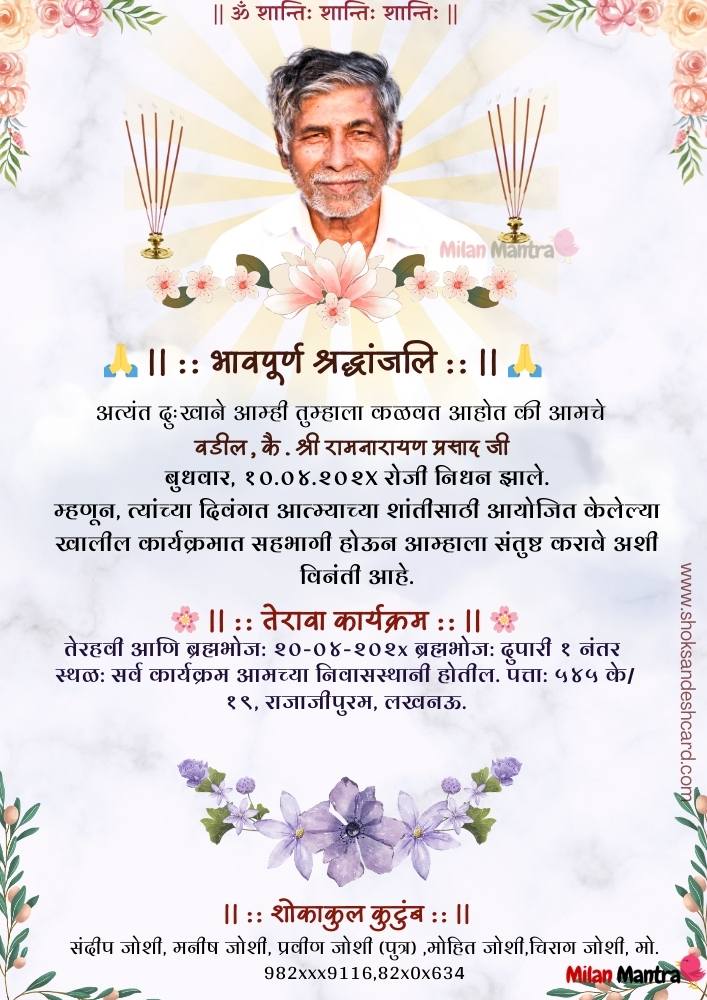





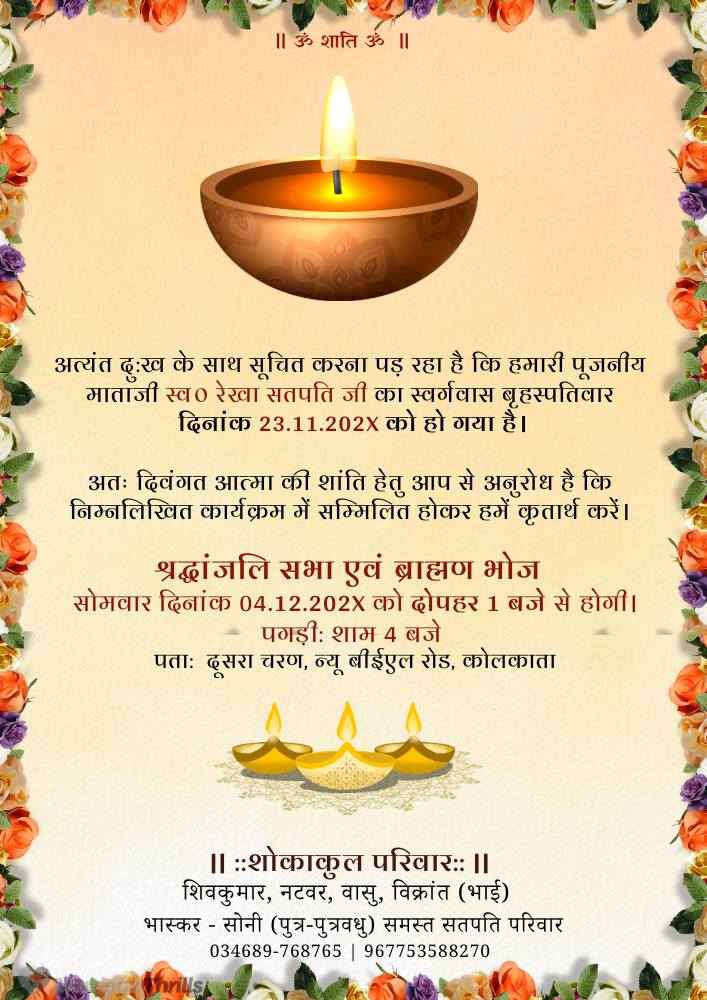
🌍 English Condolence Card – Shok Sandesh in English
English death notice, prayer meeting & tribute cards — 13 designs

.jpg)
.jpg)
.jpg)
.jpg)
सभी Cards एक जगह — पूरी तरह Free
7 languages • 100+ designs • Instant PDF + WhatsApp ready
💡Frequently Asked Questions
What is a good short condolence message?
A good short condolence message is: 'My heart goes out to you and your family during this incredibly difficult time. Wishing you strength and comfort.'
How do I reply to 'Sorry for your loss'?
A simple 'Thank you for your kind words' or 'I appreciate your thoughts and prayers' is completely sufficient.
🔍 Explore Related Topics

आदित्य शर्मा
Bereavement counselor & writer | 7 years of writing compassionate tributes